
What Temperature Data Is Actually Useful in a Food Safety Audit
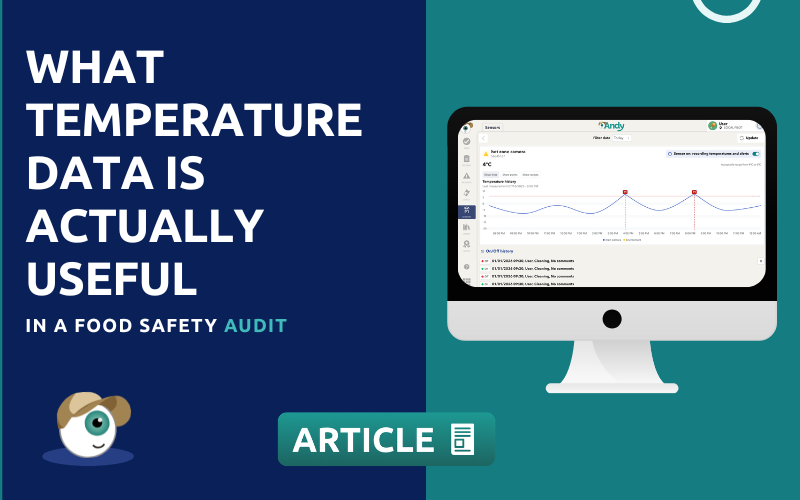
During a Food Safety Audit, temperature records are usually one of the first elements an auditor reviews.
However, having data does not always mean having control.
Many establishments record temperatures every day, but when the audit arrives, common problems appear: incomplete records, lack of context, or data that does not demonstrate that the system is functioning properly.
That is why the key is not simply recording temperatures, but recording the right information to demonstrate real control of the process.

What auditors look for in temperature records
Auditors do not only check whether a record exists. They also analyse whether that record demonstrates that the HACCP system is working in a structured and consistent way.
They usually review five key aspects:
- Frequency of checks
- Clear identification of the control point
- Person responsible for the record
- Corrective actions in case of deviations
- Access and traceability of the information
If any of these elements are missing, the record loses value during the audit.
What temperature data is essential in a food safety audit?
For a temperature record to be useful during a food safety audit, it should include:
- Date and time of the check
- Specific equipment or control point
- Temperature recorded
- Identification of the responsible person
- Corrective action if the temperature is outside the acceptable range
These elements help demonstrate that temperature monitoring is part of the daily operational system rather than a one-off record.
Frequency of temperature checks
One of the first aspects an auditor reviews is the consistency of the records.
Temperature checks must follow the frequency defined in the HACCP plan.
For example:
- Checking refrigeration units at the start of each shift
- Verifying temperature during goods reception
- Monitoring critical processes such as cooking or hot holding
When there are gaps in the records, the auditor may question whether the control procedure is actually being followed.
Clarity of the control point
A useful record must clearly indicate which equipment or process is being monitored.
For example, a generic record such as:
“Fridge: 4 °C” provides very limited information.
In contrast, a more precise record such as:
“Fresh product refrigeration unit – 4 °C” clearly identifies the control point within the HACCP system.
This level of precision makes analysis during the audit much easier.
Why are corrective actions important in temperature records?
During an audit, it is not enough to simply record a temperature deviation.
It is also necessary to demonstrate that the team acted to correct it.
A complete record should include:
- Temperature deviation detected
- Corrective action taken
- Follow-up measurement confirming the correction
This demonstrates that the monitoring system not only detects problems but also manages them.
Traceability and access to records
During an audit, time is limited.
If records are scattered across paper logs or different documents, it can be difficult to demonstrate that the system is working properly.
For this reason, more and more companies are digitising temperature monitoring in order to:
- Access records quickly
- Display full historical data
- Detect deviations more rapidly
- Maintain clear process traceability
Digitalization greatly simplifies the audit process and reduces the risk of documentation errors.
Temperature data is a fundamental part of food safety systems, but its value during an audit depends on how it is recorded.
The most useful records are those that clearly demonstrate:
- Consistency in monitoring
- Clarity of control points
- Operational responsibility
- Documented management of deviations
When these elements are present, the auditor can quickly verify that the HACCP system is functioning in a structured and reliable way.
Try Andy
Recording temperatures on paper can lead to errors, missing information, or difficulties during an audit.
Andy allows teams to digitize temperature checks, maintain full traceability, and detect deviations in real time.
When an audit takes place, all information is organized, accessible, and ready to demonstrate that the system is working correctly.
👉 Discover how Andy can help simplify food safety control.
