

HACCP records: how to turn them into operational intelligence
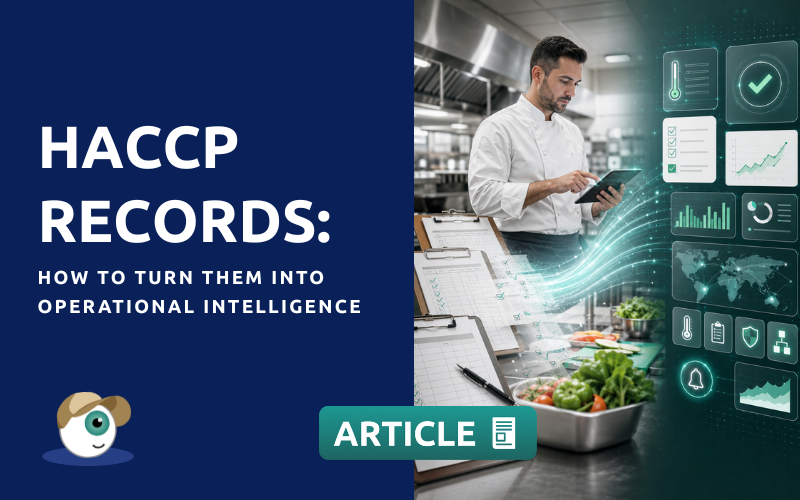
Recording information is not the same as understanding it.
Every day, food service teams complete temperature checks, cleaning records, goods reception controls, cooling logs, maintenance tasks and incident reports.
Across a multi-site operation, this can generate hundreds or even thousands of food safety data points.
Yet much of this information is filed away and rarely reviewed until an audit takes place.
The records may demonstrate that a control was completed, but they do not automatically explain what is happening across the operation or where the next risk may appear.
This matters. According to updated estimates published by the World Health Organization in 2026, contaminated food causes around 866 million cases of illness and 1.52 million deaths worldwide every year. Strong food safety controls are essential, but so is the ability to interpret the information those controls generate.
When they are digitalized, centralized and analyzed properly, HACCP records stop being a collection of completed fields.
They become operational intelligence that can help businesses identify patterns, anticipate risks and make better decisions.

How to turn HACCP records into operational intelligence
1. HACCP records often remain isolated data points
A temperature record may show that a cold room reached 7°C at 10:00 am. The team registers the deviation, takes corrective action and continues with the working day. From a compliance perspective, the process may appear complete.
However, one isolated reading tells only a small part of the story. To understand what is actually happening, food safety and operations teams need to answer wider questions:
- Is this the first deviation or does it happen every week?
- Does it always affect the same cold room or time of day?
- Are similar deviations appearing at other locations?
- How long does it take teams to respond?
- Is the corrective action addressing the cause or only the immediate symptom?
When HACCP records are distributed across paper forms, spreadsheets, emails and separate applications, answering these questions takes time. It may also require a minor archaeological expedition through folders labelled “Final”, “Final new” and the timeless classic, “Final version 3”.
2. Deviations are managed as one-off events
In a busy food service environment, every incident requires an immediate response.
A temperature outside the accepted range, an incomplete cleaning task or a missed control must be addressed so that the operation can continue safely.
The problem begins when every deviation is treated as an independent event. Without a consolidated view of HACCP records, it becomes difficult to recognise that several apparently separate incidents may have the same underlying cause.
For example, delayed controls may regularly occur during shift changes. Temperature deviations may increase after deliveries. Incomplete tasks may be more common at locations experiencing high employee turnover or insufficient training.
Without centralized data, these connections remain hidden. The business continues correcting individual problems without learning from them. Teams spend their time responding to operational fires, while the process that keeps producing the sparks remains untouched.
3. HACCP records are prepared for audits rather than operations
For European food businesses, Regulation (EC) No 852/2004 requires operators to establish, implement and maintain permanent procedures based on HACCP principles. Businesses must also maintain appropriate documents and records that demonstrate the effective application of those procedures.
This requirement has led many organisations to view HACCP records mainly as evidence of compliance. The priority becomes proving that a check was completed, when it took place and who was responsible.
This information is necessary, but its potential value goes much further. Codex Alimentarius guidance identifies accurate record-keeping as an essential part of an effective HACCP system. Records should support verification, review and the assessment of whether controls are working as intended.
A HACCP record should not only help reconstruct what happened when an auditor arrives. It should also help teams manage what is happening today and reduce the likelihood of the same problem returning tomorrow.
4. Centralize HACCP records and turn them into useful information
The first step towards operational intelligence is bringing food safety information into one shared system. With Andy, teams can digitalise and centralize records, tasks, incidents, audits and corrective actions within a single platform.
This helps standardize how information is collected across every location. It also reduces common issues such as incomplete fields, inconsistent formats, illegible handwriting or records that cannot be found when they are needed.
Each record can be connected to relevant operational information, including:
- The location and operational area where the control was completed.
- The employee or team responsible.
- The date and time of the control.
- The result or value recorded.
- Any deviation identified.
- The corrective action taken.
- Supporting evidence, such as photographs or comments.
As a result, digital HACCP records are no longer static documents. They become structured, searchable and comparable information that can be accessed by food safety, quality and operations teams.
This is particularly valuable for multi-site organizations. Instead of requesting files from every location or manually consolidating several spreadsheets, central teams can gain a consistent view of performance across the entire business.
5. Use HACCP data to detect patterns and act earlier
The real value of digital records appears when accumulated data begins to reveal trends. Andy helps businesses review deviations, analyse compliance and compare activity across individual locations or the wider organization.
Managers can identify which controls generate the most incidents, which sites require additional support, when non-compliance is more likely to occur and whether corrective actions are solving the underlying problem.
This allows teams to move beyond descriptive questions and focus on operational decisions:
- Which processes are generating recurring deviations?
- Where is the level of food safety risk increasing?
- Which locations need additional training or supervision?
- Which equipment or operational areas require maintenance?
- Which corrective actions are producing measurable improvements?
These insights can help organizations prioritise resources, adapt procedures, improve training and strengthen preventive controls. They also make audit preparation more efficient because records, corrective actions and supporting evidence are already organised and accessible.
Instead of waiting for an incident to become serious, businesses can use existing HACCP records to recognize early warning signs and intervene sooner.
From documenting the past to improving the next shift
Records are an essential part of any food safety management system. Their value, however, should not end when an employee completes a field or signs a form.
When food safety data is centralized, connected and analyzed, it provides a clearer picture of the operation. Every temperature reading, missed task, incident and corrective action offers a small signal. Together, these signals reveal where risks are developing, which processes need attention and where operational improvements can be made.
With Andy, HACCP records can become more than documents prepared for an audit. They can become an active tool for managing risk, improving consistency and supporting better operational decisions across every location.
Would you like to transform the food safety data your teams already generate into faster, more reliable decisions?
