

Digital records in food service: what inspectors look for
Health inspections remain one of the most critical moments in any food service operation. However, what many teams don’t always realize is that an inspector is not simply looking for things to be “done”, but for them to be verified clearly, quickly, and reliably. In this context, digital records in food service are fundamentally changing how compliance is assessed.
Beyond regulations, what is truly at stake is the ability to demonstrate real operational control. And this is where digitalization makes a clear difference.

What inspectors are really looking for during an inspection
Although each authority may have its own nuances, inspectors tend to focus on three key aspects: consistency, traceability, and evidence.
First, they look for consistency. In other words, records must make sense within the broader operation. It is not enough to have completed forms; the data must reflect a coherent operational reality.
Second, traceability. The ability to follow the path of a product, an incident, or a corrective action without gaps or contradictions is essential. This includes knowing what happened, when, who carried it out, and how it was resolved.
Third, evidence. Inspectors need clear proof that controls have been carried out correctly and at the right time. Not interpretations, not reconstructions after the fact.
In this scenario, digital records in food service respond far more effectively to these needs than traditional paper-based systems.
Why paper is no longer enough
For years, paper records have been the standard in the industry. However, they present significant limitations that directly impact inspections.
The main issue is the lack of real-time reliability. Records can be completed retrospectively, with errors or even based on estimates. This raises doubts about the accuracy of the information.
In addition, access to information is slow and fragmented. Reviewing folders, loose sheets, or incomplete documents makes the inspector’s job more difficult and unnecessarily prolongs the process.
Finally, paper does not support traceability effectively. Linking incidents, corrective actions, and previous controls requires time and, in many cases, interpretation.
All of this not only complicates inspections but also creates a perception of lack of control, even when the day-to-day work is actually being carried out properly.
How digital records make inspections easier
The main advantage of digital records in food service is that they turn inspections into a far more transparent and structured process.
Firstly, they provide immediate access to information. An inspector can review records, historical data, and evidence in seconds, without relying on physical files or manual searches.
Secondly, they ensure data integrity. Records are tied to a specific moment in time, preventing later modifications and increasing confidence in the information.
They also significantly improve traceability. Controls, incidents, and corrective actions can be connected within a single workflow, making it easier to understand what happened and how it was managed.
In addition, digital records allow patterns to be identified. An inspector is not just seeing isolated data points, but a timeline, providing a much more complete picture of operational control.
Faster, clearer, and frictionless inspections
When an operation uses digital records in food service, the inspection dynamic changes completely.
The process becomes more agile. What once required reviewing multiple documents can now be resolved in minutes. This reduces stress and improves the experience for both the inspector and the team.
Communication also improves. With clear, structured information available, there is less room for doubt, interpretation, or unnecessary explanations.
Above all, it conveys a sense of real control. It is not just about complying, but about demonstrating that the operation is under control at all times.
Beyond inspections: real operational control
While the impact on inspections is clear, digital records in food service deliver value far beyond compliance.
They enable teams to detect issues before they become major incidents, improve coordination, and reduce the time spent on administrative tasks.
In other words, they do not just help you “pass an inspection”, they help you operate better every day.
The role of Andy in digital record-keeping
In this context, Andy, the leading digital assistant for food service operations, takes digital record-keeping to an entirely new level.
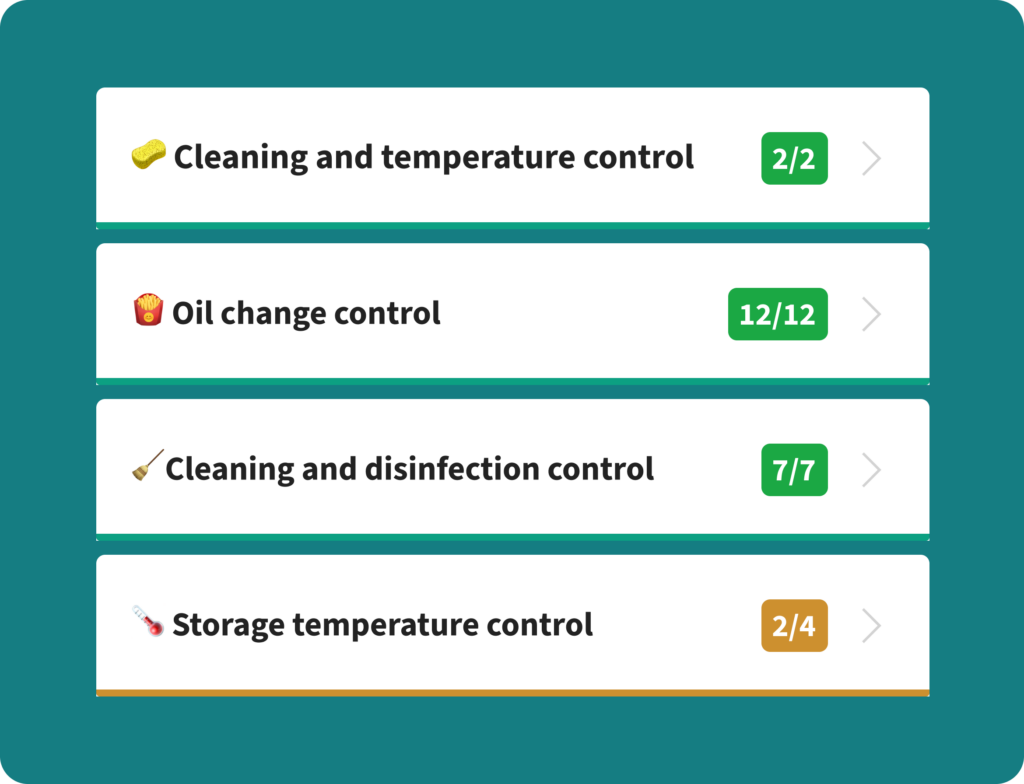
Andy does not simply replace paper, it transforms how compliance is executed, monitored, and demonstrated in daily operations. Everything is connected within a single operational workflow, making life easier for both teams and inspectors.
Key advantages include:
- Full centralization of information: all records, HACCP controls, audits, and incidents in one place
- Complete traceability: every action is logged with date, time, and responsible user
- Instant access to information: real-time data available during any inspection
- Greater reliability: elimination of incomplete, duplicated, or backfilled records
- Integrated processes: tasks, controls, sensors, and labeling connected within the same workflow
- Operational visibility: clear oversight of the status of each site or team at all times
- Continuous inspection readiness: not preparing for audits, but always being ready
In an environment where expectations continue to rise, digital records in food service are no longer an optional improvement, but a key tool to ensure control, safety, and efficiency. Andy turns this necessity into a real and sustainable operational advantage.
