

What Does a Food Safety Inspector Really Look For?
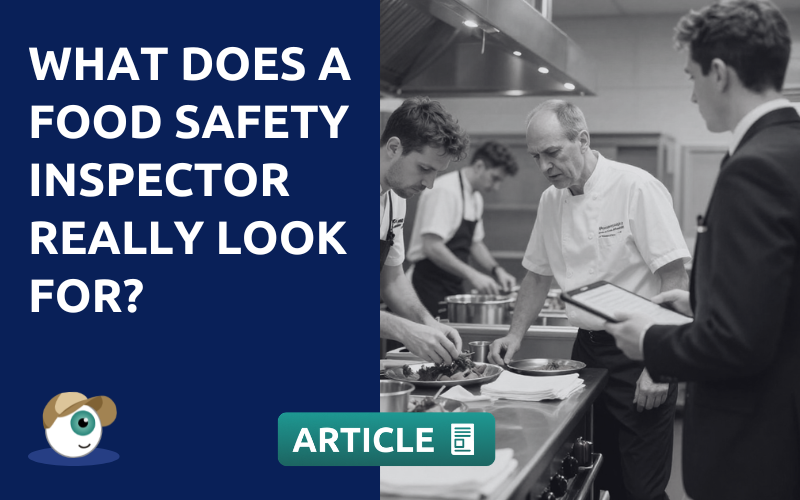
When a food safety inspector enters a food service site, they are not looking for random mistakes.
They are assessing whether your food safety system works – consistently, structurally, and over time.
While specific criteria may vary depending on the authority, inspections typically focus on a set of core areas. Understanding these helps shift the mindset from “inspection day panic” to daily operational control.
Here’s what is usually reviewed.

What Does a Food Safety Inspector Really Look For?
1. Temperature Control
Temperature management is one of the most critical control points in any food operation.
Inspectors typically check:
-
Fridge and freezer temperatures
-
Hot holding temperatures
-
Historical temperature records
-
Calibration of thermometers
It is not enough for temperatures to be correct at the time of inspection.
Inspectors need evidence that control is continuous and properly recorded.
Gaps in logs, inconsistent entries, or retrospective documentation are common areas of concern.
2. HACCP System
A HACCP plan should be a working system – not a static document stored in a folder.
An inspector may review:
-
Hazard analysis
-
Identification of Critical Control Points (CCPs)
-
Defined critical limits
-
Monitoring records
-
Corrective actions taken when limits were exceeded
Deviations can happen in any operation. What matters is whether they were identified, recorded, and corrected appropriately.
The focus is on control and traceable evidence.
3. Traceability
Traceability is essential for responding to food safety alerts.
Inspectors may request:
-
Supplier documentation
-
Delivery records
-
Batch or lot identification
-
Ability to trace a product forward and backward
Operationally, the key question is simple:
Can you identify where this product came from – and where it went – quickly?
If traceability requires searching through disconnected paperwork, the system is vulnerable.
4. Staff Hygiene and Food Handling Practices
Direct observation plays an important role.
Inspectors may assess:
-
Handwashing practices
-
Use of protective clothing
-
Separation of raw and ready-to-eat foods
-
Cross-contamination controls
Training records may also be reviewed to confirm that staff understand procedures – not just that they exist.
Consistency between written procedures and real-life practice is crucial.
5. Cleaning and Maintenance Systems
Clean premises are expected – but inspectors are primarily interested in the system behind them.
They may review:
-
Cleaning schedules
-
Signed records
-
Verification checks
-
Preventive maintenance procedures
A structured cleaning system demonstrates ongoing control rather than reactive cleaning.
Internal Audits and Digital Oversight
Beyond official inspections, many food businesses carry out regular internal audits to identify gaps before authorities do.
Across audits conducted using Andy’s digital compliance system, recurring improvement areas typically include:
-
Incomplete or late temperature records
-
Corrective actions not fully documented
-
Inconsistencies between written procedures and operational practice
-
Lack of real-time visibility across multiple sites
Digital internal audits allow teams to:
✔ Access historical records instantly
✔ Detect recurring patterns or weak points
✔ Standardize procedures across locations
✔ Strengthen traceability with time-stamped data
The goal is not simply to “pass inspections.”
It is to ensure compliance is embedded into daily operations.
When documentation is structured, centralised, and verifiable in real time, inspections become validation exercises rather than crisis moments.
What Inspectors Ultimately Look For
In practical terms, inspectors are looking for four things:
- Control
- Evidence
- Consistency
- Ability to respond to issues
They do not expect absolute perfection.
They expect a system that works – even when management is not present.
Final Thought
The real question is not:
What should we do when the inspector arrives?
It is:
Would our system hold up tomorrow if no one reminded the team?
Food safety inspections are not won on the day.
They are built into everyday operations.
